Last year, I sat in a Zoom with a nonprofit executive director who told me her brand was "strong." Her team loved it. Her board loved it. Then I showed her what happened when I asked ChatGPT about her organization. It described her competitor. Not their organization.
She had no idea. And that single finding changed the entire engagement.
That is what a brand audit does. It shows you the gap between the brand you think you have and the one your audience actually experiences. I have run these audits at Slam Media Lab (Slam) for nonprofits, startups, and VC firms across the Bay Area, and the pattern is always the same: leadership is surprised. The brand they describe in meetings is different from the brand their website communicates, their social media projects, and their search results display. The audit makes that gap visible so you can fix it with data instead of guessing.
This guide walks through what a brand audit agency actually evaluates, the exact process we follow, what we typically find, what it costs, and how to know if you need one.
What a Brand Audit Actually Evaluates (and Why Most Companies Skip the Hard Parts)
Most brand audit guides will tell you to "assess your brand touchpoints." That is not useful. Here is what we actually look at, and the specific questions that surface the problems worth fixing.
Your Internal Alignment (Where 80% of Brand Problems Start)
I ask every person on the leadership team the same question: "In one sentence, what does your organization do and who is it for?" If I get five different answers from five people, that is finding number one. And I get five different answers roughly 70% of the time.
What we assess:
- Can your team articulate your positioning? One sentence. No jargon. If they cannot, your audience definitely cannot.
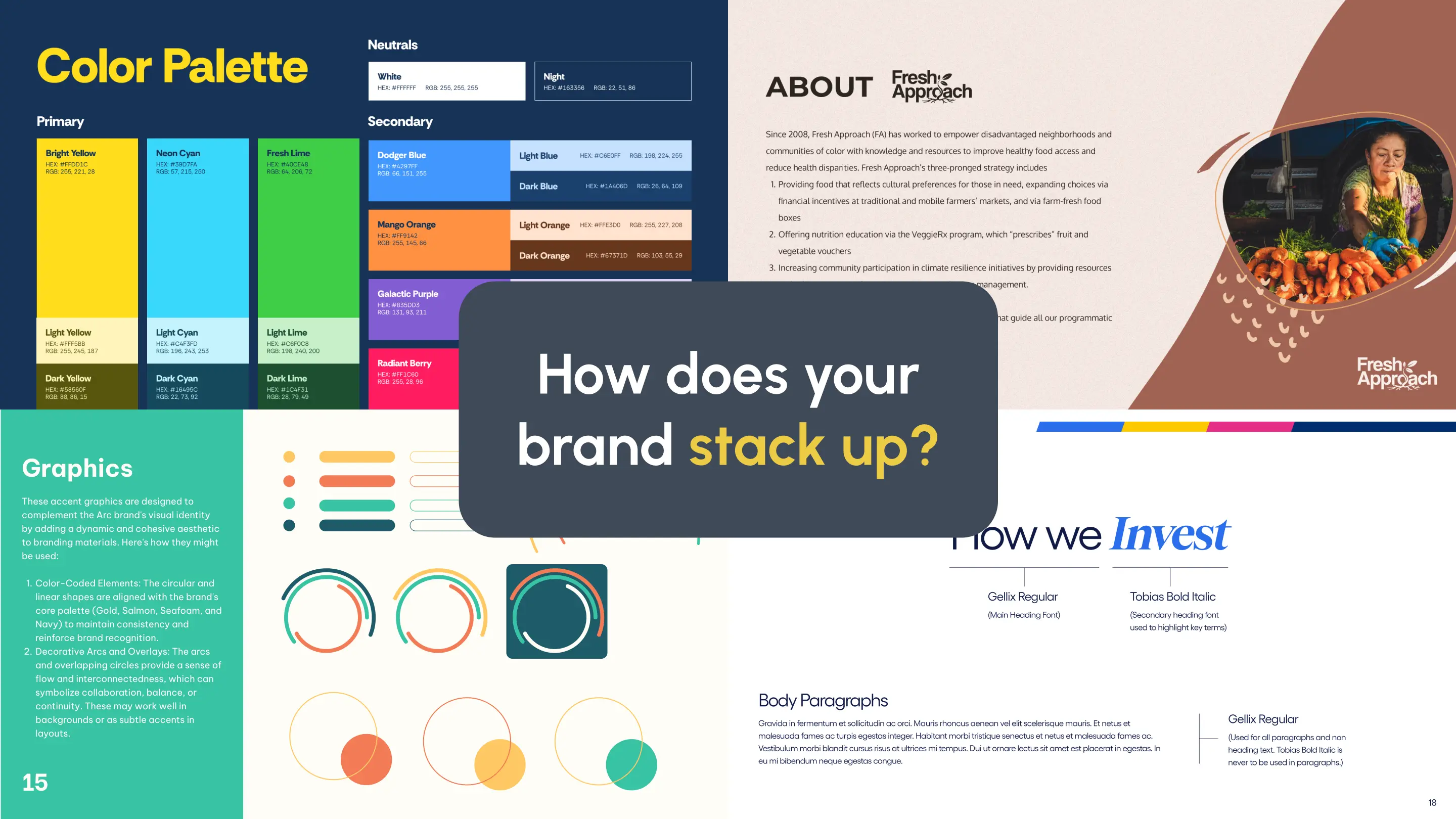
- Are people using the right brand assets? We pull every logo version being used across your website, social media, email signatures, pitch decks, and event materials. At Fresh Approach, we found four different logo versions in active use. That is not unusual.
- Does the stated mission match the operational reality? If your brand says "innovation" but your website has not been updated since 2019, the gap is visible.
Your Digital Brand (Where Your Audience Forms Their Opinion)
94% of first impressions are design-related, according to research from the Missouri University of Science and Technology. Your website is your brand for most people. We evaluate it like a prospective client would, not like a designer would.
What we assess:
- Website speed and mobile experience. If your site loads in over three seconds on a phone, you lose half your visitors before they see your name. We run every site through PageSpeed Insights and test the mobile experience on three device sizes.
- Content quality vs. competitor content. We read your top 10 pages and your competitors' top 10 pages side by side. The difference is usually stark. Your competitors may be publishing research, case studies, and actionable guides while you have a blog that has not been updated in eight months.
- Search visibility. What appears when someone Googles your organization? What do AI tools like ChatGPT, Gemini, and Perplexity say about you? We built Slam's GEO optimization practice specifically because AI-generated answers are now a major brand touchpoint. If you are not showing up in AI results, you are invisible to a growing segment of your audience.
- Social media consistency. Same logo? Same colors? Same tone? Or does every platform feel like a different organization?
- Conversion flow. We test your highest-intent page (donate, contact, apply) as a first-time visitor. The number of unnecessary form fields, slow load times, and broken mobile layouts we find is staggering.
Your Market Position (Where You Sit vs. Where You Think You Sit)
This is the part most organizations skip when they try to audit themselves. You cannot objectively assess your own competitive position.
What we assess:
- Competitive landscape. We audit 3-5 peer organizations across the same criteria. Where are you stronger? Where are you weaker? Where is there open space nobody is claiming?
- Keyword territory. What search terms do you own vs. what terms your competitors own? This is where SEO intersects with brand strategy. If your competitor ranks #1 for the term your audience searches most, your brand has a visibility problem.
- Share of voice. How often is your organization mentioned vs. peers in media, search results, and AI-generated answers?
The Exact Process We Follow (Week by Week)
I am sharing our actual process because I believe transparency builds trust. If you read this and decide to run the audit yourself, that is fine. If you read this and realize you want someone objective to do it, we are here.
Week 1: Collecting the Evidence
- Stakeholder interviews (5 to 8 people). We ask leadership, frontline staff, and board members the same core questions. The divergence in answers is the most revealing data point. When someone says "we are a research organization" and someone else says "we are an advocacy organization," that is a positioning problem hiding in plain sight.
- Audience interviews (10 to 15 people). We talk to the people who matter most: your donors, clients, beneficiaries, or partners. What do they think you do? What do they value? What would they change? The answers often contradict what leadership assumes.
- Full digital audit. Website performance, SEO rankings, backlink profile, social media metrics, email engagement, AI visibility. We use Ahrefs for search analysis and Google Analytics for behavior data.
- Competitive audit. We run the same evaluation on 3-5 competitor brands.
Week 2: Finding the Patterns
Raw data is not useful. Patterns are. We synthesize everything into findings organized around gaps:
- The gap between how leadership describes the brand and how the audience describes it
- The gap between the brand promise and the actual digital experience
- The gap between your positioning and your competitors' positioning
- The gap between the keywords you should own and the ones you actually rank for
Week 3: Report and Recommendations
The audit report includes:
- Brand health score across internal alignment, digital presence, and market position
- Key findings ranked by business impact
- Prioritized recommendations with estimated effort and timeline
- Competitive benchmarking showing where you lead and lag
- Six-month action plan with specific next steps
This report becomes the foundation for every decision that follows: whether you need a rebrand, a brand refresh, a website redesign, or better consistency with what you already have.
Five Things a Brand Audit Almost Always Reveals
I have done enough of these to know the patterns. Here is what we find almost every time.
Your Website and Your Team Describe Two Different Organizations
This is the most common finding. Leadership describes an innovative, community-driven organization. The website looks like it was built five years ago, loads slowly, and features stock photography of people who do not look like the community being served. The verbal brand and the digital brand are two different entities. We cover how to fix this in our nonprofit website design guide.
Your Brand Assets Are Slowly Drifting Apart
Four logo versions across platforms. Slightly different colors on the website vs. the email template vs. the event banner. A font on social media that is "close enough" to the brand font. Each inconsistency is small. Together, they erode trust and recognition. Brands with consistent presentation see 33% higher recall. Inconsistent brands leave that on the table.
You Have Outgrown Your Brand
This is the finding that changes everything for growing organizations. Fresh Approach had evolved from a local Bay Area food access program to a statewide nonprofit, but the brand still reflected the smaller version. The audit revealed that the brand was actively limiting their ability to attract statewide funders and partners. The brand was not wrong. It was just too small for what the organization had become.
You Are Invisible in AI Search
This one surprises people the most. We check what ChatGPT, Gemini, and Perplexity say about your organization. For many of the organizations we audit, the AI either describes a competitor, gives vague or outdated information, or does not mention them at all. In 2026, AI-generated answers are a brand touchpoint. If you are not showing up, a growing segment of your audience does not know you exist.
Your Highest-Intent Page Has the Worst Experience
The donation page. The contact form. The application page. Whatever your most important conversion point is, the audit almost always reveals it has the slowest load time, the most form fields, the worst mobile experience, and the weakest brand expression. Fixing this single page often produces the fastest ROI of any audit recommendation.
Do You Need a Brand Audit? (Five-Question Self-Assessment)
Answer honestly:
- Can every person on your leadership team describe what your organization does, who it serves, and what makes it different in one consistent sentence?
- Does your website accurately reflect who you are today, or who you were two years ago?
- When you Google your organization, are you satisfied with what appears?
- If you asked 10 people from your target audience to describe your organization, would they all say the same thing?
- Have you checked what AI tools (ChatGPT, Gemini, Perplexity) say about you?
If you answered "no" or "I don't know" to two or more, a brand audit will save you money by showing you exactly where to invest instead of guessing.
What a Brand Audit Costs
I am publishing real pricing because most brand audit agency websites refuse to. Here are the actual ranges.
- DIY brand audit (self-assessment, free tools): $0 to $500. You get a surface-level view. You miss the competitive benchmarking and the objective outside perspective, which is where the most valuable findings come from.
- Boutique agency audit (what Slam typically delivers): $5,000 to $15,000. Full stakeholder and audience interviews, digital audit, competitive analysis, and a prioritized recommendations report. This is the sweet spot for growing nonprofits, startups, and mid-market companies.
- Large agency audit (enterprise scope): $25,000 to $50,000+. Multi-division organizations, extensive primary research, global brand architecture assessment.
- Research-driven audits (consumer perception studies): $100,000+. Custom surveys, focus groups, quantitative brand tracking. Reserved for large organizations with established brands.
At Slam, brand audits are typically the first phase of a broader brand strategy engagement. The audit answers "what is the problem?" The strategy work that follows answers "how do we fix it?" Combining them into one engagement saves time and avoids the gap that happens when one agency audits and a different agency implements.
How often should you audit? The industry standard is a comprehensive audit every 12 to 18 months, with quarterly check-ins on key metrics (website performance, search rankings, AI visibility). If you have gone through a leadership change, launched new programs, or entered new markets, audit sooner.
Why Slam Runs Better Brand Audits
Most brand audit agencies stop at the visual layer. They check your logo, your colors, your website, and hand you a PDF. That misses half the picture.
Here is what we do differently:
- We audit your AI visibility. No other agency I know of includes GEO auditing as a standard part of their brand audit. We check what ChatGPT, Gemini, Perplexity, and Google AI Overviews say about you, and we compare it to what they say about your competitors. In 2026, this is the brand touchpoint most organizations are ignoring.
- We connect brand to revenue. Our audits do not stop at "your brand is inconsistent." We show you the revenue implications. If brand consistency drives up to 33% more revenue, we calculate what you are leaving on the table and prioritize fixes by dollar impact.
- We implement what we find. Most audit agencies hand you a report and leave. We build brand identities, design Webflow websites, and run SEO programs. The same team that finds the problems is the team that fixes them. One relationship. One context. Zero handoff loss.
- You work directly with senior strategists. No account managers. No juniors running your audit. The people doing the analysis are the people who have driven $2B+ in client revenue and built search programs from zero to millions of organic searches.
We have run audits for Bay Area organizations like Fresh Approach (where the audit revealed the brand had outgrown its positioning), Equis Labs (where the audit showed the visual identity was undermining the organization's credibility), and Symphonic Capital (where the audit confirmed the brand was indistinguishable from competitors). Each audit led to a brand strategy engagement that solved the specific problems the data surfaced.
If you suspect your brand is holding you back but you are not sure where, book a consultation. I will give you an honest read on whether an audit is the right first step.
Brand Audit Agency FAQ
How Long Does a Brand Audit Take?
A comprehensive brand audit takes 2 to 3 weeks at Slam: one week for data collection (interviews, digital audit, competitive analysis), one week for synthesis and pattern recognition, and a few days for report writing and presentation. Larger organizations with multiple divisions may need 4 to 5 weeks.
What Does a Brand Audit Cost?
Brand audits range from $5,000 to $50,000+ depending on scope. Boutique agencies like Slam typically charge $5,000 to $15,000 for a full audit including stakeholder interviews, audience research, digital audit, competitive analysis, and a prioritized recommendations report. At Slam, audits are often the first phase of a broader brand strategy engagement rather than a standalone deliverable.
Can We Do a Brand Audit Ourselves?
You can do a basic version. Survey your team with the five positioning questions. Run your site through PageSpeed Insights. Check your social media for visual consistency. Ask 10 people from your target audience what they think you do. The value of hiring a brand audit agency is objectivity, competitive benchmarking, and AI visibility analysis. Those are hard to do from inside the organization.
What Is the Difference Between a Brand Audit and a Website Audit?
A website audit evaluates technical performance, SEO, and user experience for your site. A brand audit evaluates your entire brand across every touchpoint: website, social, email, print, internal culture, competitive position, AI visibility, and audience perception. The website audit is one component of the brand audit.
What Happens After a Brand Audit?
The audit produces a prioritized set of recommendations. Common next steps include: positioning refinement, visual identity redesign, website redesign, content strategy development, SEO investment, or GEO optimization. The audit tells you which investment will have the highest impact, so you stop guessing and start fixing.
How Often Should a Company Audit Its Brand?
Run a comprehensive audit every 12 to 18 months. Quarterly, check the key metrics: website performance, search rankings, social engagement, and AI visibility. Audit sooner if you have gone through a leadership change, launched new programs, expanded to new markets, or merged with another organization.
.png)