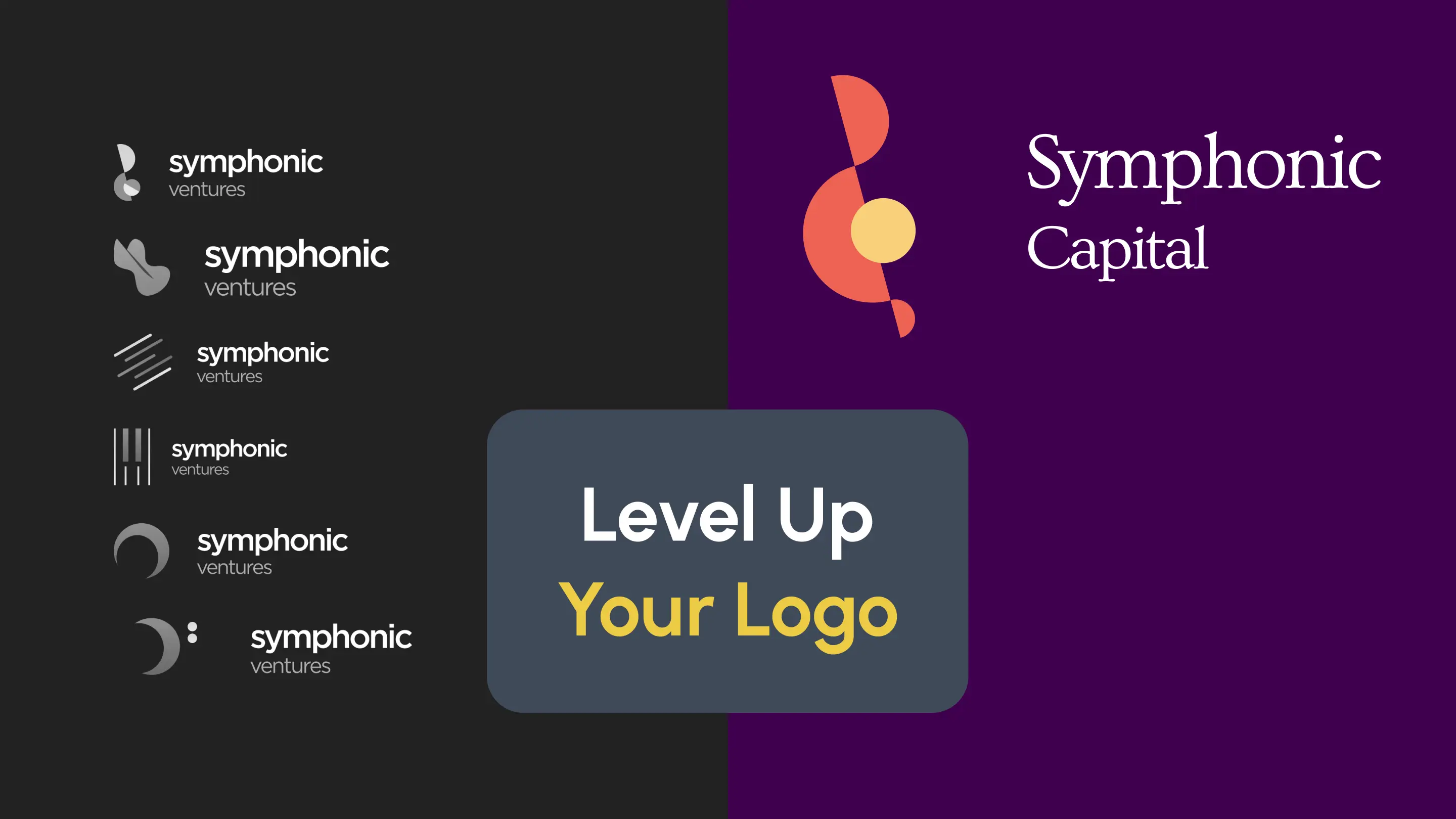
When Sydney, founder of Symphonical Capital came to us to build the brand for her new VC firm, we started with her Spotify playlist. Not her competitor analysis. Not a mood board of other VC logos. Her music.
That sounds strange until you understand why. Every VC firm in San Francisco looks the same. Geometric mark. Navy blue or black. Sans-serif wordmark. Clean, corporate, forgettable. Sydney wanted the opposite. She wanted a brand that conveyed confidence without being masculine, excellence without being corporate, and warmth without being soft.
The name "Symphonic" gave us the concept: diverse instrumentalists, each at the top of their craft, creating something together that none could create alone. The logo reflects that harmony. The color palette is bold, playful, and elegant. The whole system is deliberately different from every other VC brand in the Bay Area. Founders and LPs now reference it unprompted as distinctive. That is what happens when a logo is rooted in something real instead of a trend.
At Slam Media Lab (Slam), we design logos as part of complete brand identity systems. We have done this for Bay Area organizations like Symphonic Capital, Luminary Impact Fund, and Acumen America. This guide covers what San Francisco logo design actually costs, the mistakes I see SF companies make repeatedly, and what separates a logo that lasts from one you rebrand in two years.
The Mistakes San Francisco Companies Keep Making With Logos
I have reviewed hundreds of logos from SF startups, nonprofits, and growing companies. The same five mistakes show up constantly.
Mistake 1: Designing for the Pitch Deck, Not the Favicon
Your logo will appear at 500 pixels on a projector exactly once: your pitch deck presentation. It will appear at 16 pixels as a browser favicon thousands of times. At 40 pixels as a social media avatar, every single day. On a phone screen in bright sunlight. On a cheap vinyl banner at a conference.
Most logos are designed and approved on a 27-inch monitor in a well-lit office. They look beautiful there. They break everywhere else.
At Slam, we test every logo at the smallest size, the lowest resolution, and against the worst backgrounds before we present it. The Symphonic Capital logo works as a full lockup on the website header and as a standalone mark at 16 pixels. The Luminary Impact Fund logo (a sun with a circular cluster of family members forming a circle of wholeness and belonging) reads at every size because the form is simple and the concept is clear.
The test: Shrink your logo to 32 pixels. Can you still tell what it is? If not, your logo needs work.
Mistake 2: Following the Trend of the Moment
In 2018, every startup dropped vowels (Flickr, Tumblr). In 2020, every tech company went geometric sans-serif (remember when Slack, Google, and Airbnb all started looking the same?). In 2022, every brand went gradient. In 2024, everyone tried maximalism.
Each trend dates your brand within three years. The Symphonic Capital logo does not reference any trend. It references the client's actual positioning. That is why it will still look right in 2030.
The rule: If your logo could be guessed to a specific year based on its style, it is too trendy. The best logos feel inevitable, not fashionable.
Mistake 3: Skipping Strategy and Going Straight to "Concepts"
A designer who opens Illustrator before understanding your positioning, your audience, and your competitive landscape is guessing. They might guess well. But the odds are against them.
When we designed Acumen America's identity, we needed to differentiate a US-focused impact fund from its 20-year-old parent organization (Acumen Global). The design decisions (sharp angles, 120-degree slants, high-contrast graphics) were driven by the need to signal momentum and progress. Those design choices did not come from a mood board. They came from the strategic requirement to visually separate a new entity from an established one while maintaining brand connection.
The question to ask your designer: "Can you explain the strategic reasoning behind this design choice?" If they cannot, the choice is aesthetic, not strategic.
Mistake 4: Designing a Logo When You Need a System
A logo is one asset. You need at least five:
- Primary logo (full lockup with wordmark)
- Horizontal version (for headers and narrow spaces)
- Icon-only version (for favicons, social avatars, app icons)
- Reversed versions (for dark backgrounds)
- Single-color versions (for print, embroidery, merch)
Plus: clear space rules, minimum size specifications, color codes (HEX, RGB, CMYK, Pantone), typography pairings, and documented do's and don'ts.
That is a logo system. Anything less means your brand will look inconsistent within six months because someone will stretch the logo, use the wrong color, or place it on a background where it disappears.
Mistake 5: Spending $200 on a Logo for a $2M Company
AI logo generators and $50 freelance logos exist. They are fine for a side project or a proof of concept. They are not fine for an organization that needs investors, clients, and talent to take them seriously.
The logo is the most visible artifact of your brand. It appears on every touchpoint: website, email, social, events, merch, pitch decks, contracts. A $200 logo on a $2M company communicates exactly one thing: this company does not invest in how it presents itself.
What San Francisco Logo Design Actually Costs
By tier:
- AI logo generators (Looka, Brandmark): $20 to $200. Template-based. No strategy. Every output looks like it came from the same tool, because it did.
- Freelance designers: $500 to $5,000. You get 2 to 5 concepts and revisions. Quality varies enormously. Good for organizations that already know exactly what they want.
- Boutique agencies (like Slam): $7,000 to $30,000. Strategy-led process. Logo designed as part of a complete visual identity system. Guidelines, templates, and implementation included.
- Premium agencies: $30,000 to $100,000+. Deep research, multiple stakeholder workshops, comprehensive brand architecture. For funded startups and established companies.
Most small businesses in San Francisco spend between $5,000 and $20,000 on professional logo and brand identity work. At Slam, every engagement includes strategic positioning alongside the visual design because a logo without positioning is decoration.
What Logo Design Trends Actually Matter in 2026
I follow trends to understand what is happening in design culture. I do not follow them to design logos. There is a difference. Here is what is actually shifting in ways that affect how logos should be built:
Logos Are Systems Now, Not Fixed Marks
The strongest brands in 2026 design logos that adapt. The mark animates on the website. It simplifies for a favicon. It expands for a billboard. It works in dark mode and light mode. This is not a trend. It is a requirement. If your logo only works in one format, it is already outdated.
Typography Is Becoming the Primary Brand Signal
More brands are leading with custom wordmarks and making the icon secondary. This works when the name is distinctive and the typography carries personality. It does not work when the name is generic and the type is Helvetica. Symphonic Capital's wordmark carries the brand because "Symphonic" is a distinctive word. A firm called "Capital Partners" would need a strong mark to compensate for a generic name.
Warmth Over Sterility
The hyper-minimal, sterile aesthetic that dominated tech branding from 2018 to 2023 is fading. Brands want personality again. Rounded forms, warm colors, custom illustration, subtle texture. The Luminary Impact Fund identity uses warm tones and gentle gradients to signal comfort and belonging. That warmth is not decorative. It is strategic: their audience is families navigating mental health.
AI Changed Exploration, Not Strategy
Midjourney and other AI tools are useful for exploring visual directions during discovery. "Show me a brand identity that feels warm, community-driven, and modern." The output is not a logo. It is a conversation starter that aligns the team on direction before a designer opens Figma. The strategy, the positioning, the craft of making a mark that works at every size still requires a human designer.
How Slam Designs Logos in San Francisco
Our process for every logo engagement:
Discovery: We start with our brand discovery questionnaire. For Symphonic Capital, discovery included Sydney's Spotify playlist, brands she admired, and deep conversations about what "excellence without corporate" actually looks like. For Luminary Impact Fund, discovery centered on how to visually represent family, healing, and belonging without being clinical.
Positioning: Before we sketch anything, we define what the logo needs to communicate, to whom, and what it needs to feel different from. Acumen America needed to signal "momentum and progress" while connecting to the parent brand. That constraint shaped every design decision.
Design: 2 to 4 directions, each rooted in the strategic brief. Concepts presented with rationale, not just aesthetics. "We chose 120-degree slants because they evoke forward motion" is a design conversation. "We thought this looked cool" is not.
Testing: Every concept tested at 16 pixels, on dark backgrounds, in grayscale, on mobile. If it breaks, we fix it before the client sees it.
System delivery: Logo suite (primary, horizontal, icon, reversed), color specifications (HEX, RGB, CMYK, Pantone), typography system, photography direction, and brand guidelines. Everything the team needs to use the brand correctly from day one.
Website implementation: We build the logo and identity directly into a Webflow website in the same engagement. The logo, the identity, and the site launch together. Zero translation loss.
See our full portfolio: Symphonic Capital | Luminary Impact Fund | Acumen America | All case studies
If you are looking for San Francisco logo design rooted in strategy, get in touch.
Frequently Asked Questions About San Francisco Logo Design
How Much Does a Logo Designer Charge in San Francisco?
Freelance designers charge $500 to $5,000 for logo-only projects. Boutique agencies charge $7,000 to $30,000 for logo design within a brand identity system. Premium agencies charge $30,000 to $100,000+. Most small businesses in SF spend $5,000 to $20,000. The price reflects whether you get a logo file or a complete strategic brand foundation.
How Long Does Professional Logo Design Take?
5 to 8 weeks from kickoff to final delivery. Discovery and strategy (1 to 2 weeks), concept development (2 to 3 weeks), refinement (1 to 2 weeks), finalization (1 week). Rush projects can be done in 2 to 3 weeks but limit creative exploration.
Should I Hire a Freelancer or an Agency for Logo Design?
Hire a freelancer if you already have clear positioning, know your audience, and just need visual execution. Hire an agency if you need strategic positioning, a complete visual identity system, and brand guidelines that keep your company consistent. For companies that also need a website, an agency that handles both eliminates the translation loss of coordinating between vendors.
What Files Should I Receive After a Logo Design Project?
At minimum: vector files (SVG, AI, EPS) for print, raster files (PNG with transparent background) for digital, PDF versions, and color specifications (HEX, RGB, CMYK, Pantone). A professional engagement also includes usage guidelines: minimum sizes, clear space requirements, incorrect usage examples, and approved color variations.
Can AI Design a Good Logo?
AI can generate visual exploration quickly and help align a team on direction during discovery. It cannot do the strategic work: understanding your positioning, testing at every size, building a system that scales, or explaining the reasoning behind design decisions. The best logos in 2026 are designed by humans who use AI as an exploration tool, not a replacement for craft and strategy.
.png)