
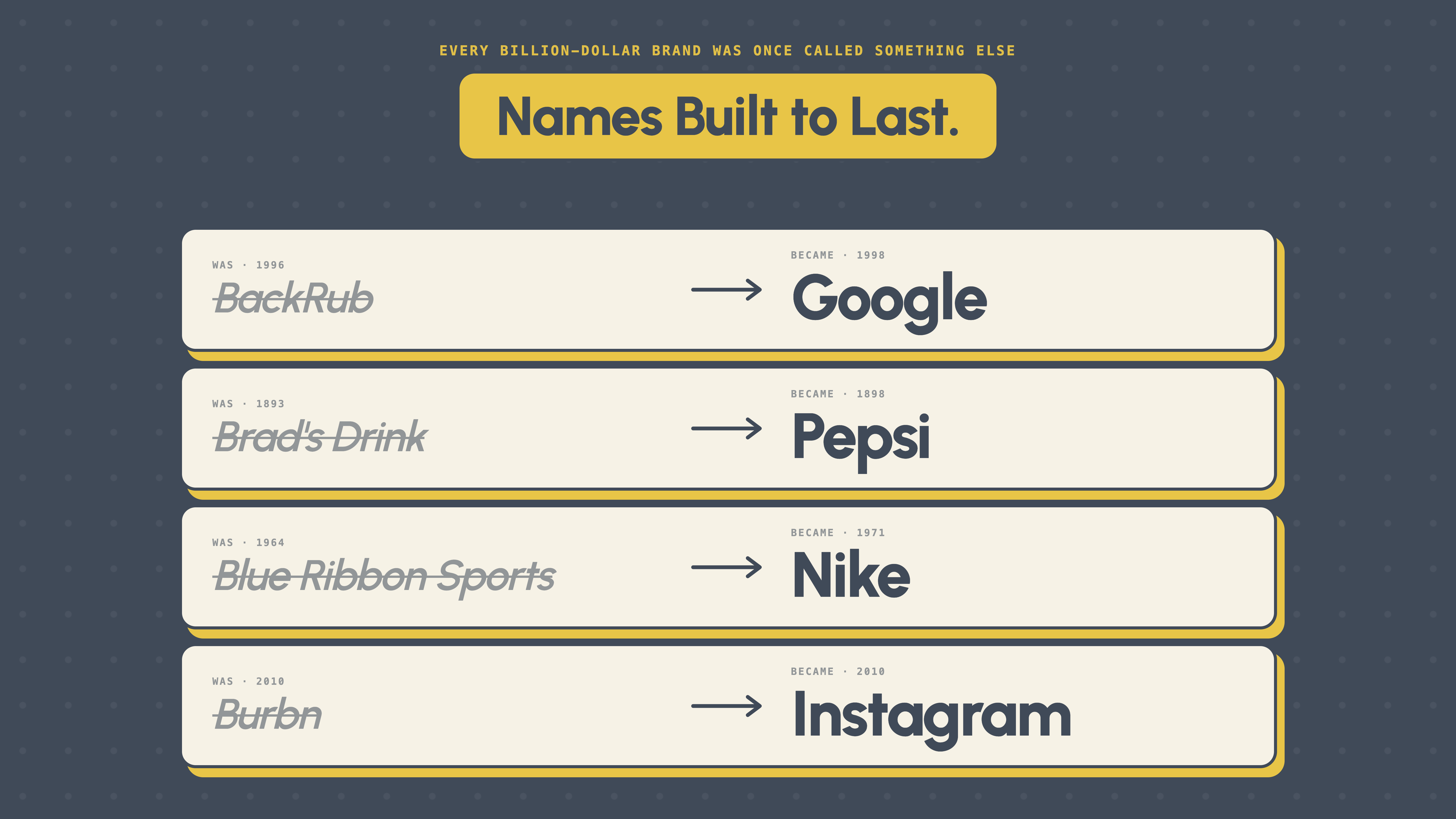
Google was originally called BackRub. Pepsi started as Brad's Drink. Instagram launched as Burbn. Nike was Blue Ribbon Sports for its first seven years.
Every one of these organizations changed their name, and the new name became worth billions. The right name carries a brand. The wrong one buries it.
Royal Mail rebranded to "Consignia." It cost £2 million and customers could neither pronounce it nor associate it with the British Post Office. They reverted within a year. Mercedes-Benz entered China as "Bensi," which roughly translates to "rush to die." They changed it immediately. Flickr dropped the "e" from "Flicker" and lost 3.6 million visitors per year to the wrong domain. Yahoo reportedly paid over $600,000 to finally acquire flicker.com.
Naming is the most consequential brand decision most organizations make, and it is the one they spend the least time on. 73% of entrepreneurs who spend fewer than five hours on naming decisions regret it. Complete rebranding when a name fails costs small businesses $100,000 to $180,000 on average according to Clutch data on branding project costs.
At Slam Media Lab (Slam), we are a brand naming agency that works with nonprofits, startups, and mission-driven organizations on naming as part of our brand strategy engagements. This guide shares what we have learned about the naming process, what the research says about names that work, and how to avoid the mistakes that cost organizations millions.
What Makes a Name Work: The Research
Brand naming feels subjective. It feels like a creative exercise where someone writes names on a whiteboard and the loudest voice in the room picks the winner. The research tells a different story.
Memorability Comes From Processing Ease
Cognitive science research shows that names our brains can process quickly are remembered more easily. This is called processing fluency. Names that are easy to pronounce, easy to spell, and easy to recall outperform complex, clever alternatives.
Google. Apple. Nike. Uber. Slack. Zoom. All one or two syllables. All easy to say in any accent. All easy to type without second-guessing the spelling.
Contrast that with the names that failed: Consignia (Royal Mail), Tronc (Tribune Publishing), Mondelez (Kraft rebrand). Complex names create cognitive friction. Friction kills memorability.
Distinctiveness Beats Description
A descriptive name like "International Business Machines" tells you exactly what the company does. IBM is distinctive. Distinctive names are easier to trademark, easier to own in search, and easier to build emotional associations around.
When naming agencies evaluate candidates, they typically sort names into categories:
- Descriptive: Says what you do. "General Motors," "American Airlines." Easy to understand but hard to trademark and hard to differentiate.
- Suggestive: Hints at what you do. "Slack" suggests ease and looseness in communication. "Uber" suggests going above and beyond.
- Abstract: Carries no inherent meaning. "Google," "Kodak," "Xerox." These are blank canvases that the brand fills with meaning over time.
- Founder names: "Goldman Sachs," "Hewlett-Packard," "Bloomberg." Carries personal credibility but can limit growth beyond the founder.
The strongest names for organizations planning to scale tend to be suggestive or abstract. They give you room to evolve without the name becoming inaccurate as your offerings expand.
Sound Symbolism Is Real
Linguists have documented that certain sounds carry unconscious associations. Hard consonants (K, T, P) feel strong and decisive. Soft sounds (L, M, S) feel gentle and approachable. Vowel sounds in the front of the mouth (like the "ee" in "Blee") feel smaller and lighter, while back vowels (like the "oo" in "Boom") feel larger and heavier.
This is why luxury brands tend toward soft, flowing sounds (Chanel, Armani, Hermès) while technology brands tend toward sharp, percussive sounds (Slack, Dropbox, Stripe). The sound of your name primes emotional expectations before the audience knows anything else about you.
The Brand Naming Process We Use
Here is how a brand naming agency approaches naming systematically. This is the process we follow at Slam when naming is part of a brand strategy engagement.
Phase 1: Strategic Foundation
Before generating a single name, we define what the name needs to accomplish:
- Audience definition. Who will say this name most often? Your donors? Your investors? Your beneficiaries? A name that works for institutional investors may feel cold to community members.
- Competitive landscape. What do your peers and competitors call themselves? What naming conventions dominate your space? If every nonprofit in your sector uses "[Cause] + Foundation," a name that breaks the pattern creates instant differentiation.
- Brand personality. Is the organization warm or authoritative? Urgent or measured? Playful or serious? The name should match the personality.
- Practical requirements. Domain availability. Trademark clearance. International considerations (does the name translate poorly in any target market?). Social media handle availability.
Phase 2: Name Generation
With strategy locked in, we generate names. A productive naming sprint produces 200-400 candidates. Here is how to structure it:
- Day 1-2: Wide exploration. Generate names across all categories (descriptive, suggestive, abstract, founder). Use thesauruses, etymological dictionaries, foreign languages, compound words, and invented words. Volume matters at this stage.
- Day 3: First filter. Cut any name that fails the practical requirements (domain unavailable, trademark conflict, translation issue). Cut anything with more than three syllables. Cut anything that is hard to spell by ear.
- Day 4: Strategic filter. Does the name match the brand personality? Does it differentiate from competitors? Does it scale as the organization grows? Apply the strategic criteria from Phase 1.
- Day 5: Shortlist. Narrow to 5-10 finalists for testing.
Phase 3: Testing and Validation
This is the phase most organizations skip, and it is the most important.
- Pronunciation test. Say each name out loud 20 times. Ask five people to say it. If anyone hesitates or mispronounces it, consider cutting it.
- Phone test. Can someone understand the name when you say it on a phone call? "Our organization is called [name]." If you have to spell it, it fails.
- Google test. Search the name. What comes up? If the first three pages are dominated by an existing entity with the same name, you will struggle to own the search space.
- Domain and social check. Is the exact .com available? If the exact match is taken, is a clean variation available (.org, adding "HQ" or "team")?
- Trademark screening. Run a preliminary search on USPTO (United States Patent and Trademark Office). Full trademark clearance should be done by an attorney before final selection.
- Audience reaction. Show the top 3 candidates to 10-15 people from your target audience. Ask: what does this name make you think of? What feeling does it give you? Can you remember it tomorrow?
Phase 4: Naming Launch
A new name requires a rollout plan:
- Internal first. Brief your team, board, and key stakeholders before the public announcement. They should be ambassadors, not surprised bystanders.
- Narrative context. When you launch the name publicly, explain the "why." Airbnb explained the Bélo symbol represents belonging. Slack explained the name as an acronym for "Searchable Log of All Conversation and Knowledge." The story behind the name makes it memorable.
- Visual identity alignment. The new name should launch alongside the new visual identity. At Slam, we build name, brand identity, and website as one integrated engagement for this reason.
- SEO transition. Update your site, Google Business Profile, directories, and all digital properties simultaneously. Set up 301 redirects from old URLs. Monitor search rankings for 90 days post-launch.
Naming Mistakes That Cost Organizations Millions
Mistake 1: Naming by Committee
The board wants something that sounds prestigious. The marketing team wants something catchy. The executive director wants something meaningful. The compromise is a name that pleases everyone and inspires nobody. Naming decisions should involve a small group (2-3 people) with final authority. Everyone else provides input.
Mistake 2: Choosing Trends Over Timelessness
In the 2000s, every startup dropped vowels (Flickr, Tumblr, Grindr). In the 2010s, every company added "-ly" or "-ify" (Spotify, Shopify, Bitly). These naming trends date your brand within five years. Choose a name that will sound as relevant in 2036 as it does today.
Mistake 3: Ignoring International Markets
Mercedes-Benz's "Bensi" in China. Chevrolet's "Nova" in Spanish-speaking countries (where "no va" means "doesn't go," though this is partly urban legend, it illustrates the point). If your organization operates internationally or plans to, screen names against all relevant languages.
Mistake 4: Falling in Love Before Checking Trademarks
Spending six months building emotional attachment to a name, then discovering it infringes on an existing trademark, is devastating. Run preliminary trademark screening early in the process, before the team gets attached.
Mistake 5: Overthinking It
Some of the most successful brand names in history were chosen quickly and simply. Phil Knight's early employee suggested "Nike" from a list of options the night before a filing deadline. Jeff Bezos chose "Amazon" because it started with "A" and was the largest river in the world. The name matters, but waiting for perfection kills momentum.
How Brand Naming Connects to SEO and GEO
Your brand name directly affects your digital discoverability.
SEO impact: A distinctive name is easier to rank for in search. If your name is a common word (like "Bloom" or "Rise"), you will compete with dictionary definitions, songs, and thousands of other organizations. A more distinctive name (like "Equis Labs" or "Slam Media Lab") gives you a cleaner path to owning your branded search.
GEO impact: AI models associate named entities with specific attributes. A clear, distinctive brand name with consistent descriptions across the web creates a strong entity signal. When someone asks ChatGPT about organizations in your space, a distinctive name is easier for AI to reference accurately than a generic one.
Domain strategy: The .com still carries the most authority for SEO, but .org works well for nonprofits. Avoid hyphens, numbers, or unconventional TLDs (.io, .co) for your primary domain if possible. They create confusion and dilute brand search traffic.
We cover the broader connection between brand and search in our nonprofit SEO guide and our brand storytelling guide.
Your Name Is Your First Impression
Your brand name is said thousands of times before someone visits your website, opens your email, or attends your event. It shapes expectations before any other touchpoint. The organizations that invest in getting it right build a foundation that everything else, identity, website, content, search presence, strengthens.
At Slam, naming is part of our integrated brand strategy practice. If your current name limits your brand, or if you are launching a new organization and need a name that scales, book a free consultation.
.png)


